
A probation violation in Colorado does not automatically result in jail. When a violation is alleged, the court must first determine whether the violation actually occurred through a Colorado probation revocation hearing. Depending on the circumstances, a judge may choose several options besides incarceration, including modifying probation or allowing probation to continue with additional conditions. The outcome often depends on the nature of the violation and how the situation is addressed.
Probation Violations
Probation is often granted as an alternative to jail or prison, giving someone the opportunity to remain in the community while completing court-ordered requirements. While this opportunity can be extremely valuable, probation also comes with strict rules that must be followed carefully.
When someone is accused of violating those rules, the situation can quickly become stressful and confusing. Many people assume that any Colorado probation violation will automatically lead to jail time. In reality, that’s not always the case. Courts frequently look at the full circumstances surrounding the violation before deciding what consequences, if any, are appropriate.
Understanding how Colorado probation violations are handled can help people respond effectively if they are accused of breaking probation conditions. This article explains what constitutes a violation, how a probation revocation hearing in Colorado works, and why jail is not always the inevitable outcome many people fear.
Understanding Post-Conviction Options in Colorado
A criminal case does not always end once a sentence is imposed. Many individuals continue to deal with legal issues long after a conviction or plea. Matters that arise after sentencing are generally referred to as post-conviction issues.
Post-conviction issues can involve a wide range of legal processes. These may include probation supervision, allegations that probation conditions were violated, requests to end probation early, or motions asking the court to reconsider a sentence. In some situations, individuals may also pursue appeals or other forms of post-conviction relief if they believe legal errors occurred during their case.
Probation itself is designed to allow individuals to serve their sentence in the community rather than in jail or prison. Instead of incarceration, the court requires the individual to comply with specific conditions for a set period of time. These conditions are intended to encourage rehabilitation, accountability, and public safety.
Common probation conditions may require someone to maintain contact with a probation officer, complete treatment or educational programs, pay fines or restitution, and avoid new criminal charges. Courts also frequently require individuals to maintain employment, remain within the state unless permission is granted to travel, and avoid certain people or places.
When someone allegedly fails to comply with these requirements, the court may initiate a probation violation proceeding. However, the mere allegation of a violation does not automatically determine the outcome. The court must still review the evidence and decide how to proceed.
Record Sealing in Colorado
Although probation violations focus on compliance with a current sentence, many people eventually want to address the long-term consequences of having a criminal record. One option that may be available in some situations is record sealing.
Record sealing limits public access to a criminal case. When a record is sealed, most employers, landlords, and members of the public cannot view it through standard background checks. However, sealed records are not completely erased. Courts, law enforcement agencies, and certain government entities may still access them under specific circumstances.
Eligibility for record sealing in Colorado depends on several factors. The nature of the offense, whether the case resulted in a conviction, and whether probation was completed successfully all play a role. In addition, many cases require a waiting period before a sealing petition can be filed.
Probation violations can sometimes affect this timeline. If probation is extended or additional penalties are imposed because of a violation, the date when a case is considered “final” may change. Since record sealing waiting periods typically begin after a case is fully completed, any delay in probation completion can affect eligibility. For that reason, resolving probation issues promptly can sometimes play an important role in long-term record management.
Deferred Judgments & Case Dismissals
Another important sentencing option under Colorado law is the deferred judgment. In a deferred judgment arrangement, a person pleads guilty but the court postpones entering the conviction. Instead, the individual is placed on probation for a set period of time. If the person successfully completes all conditions during that probationary period, the court may dismiss the case instead of entering the conviction. This outcome can significantly reduce the long-term consequences of a criminal charge.
However, deferred judgments come with strict compliance requirements. If someone violates probation during a deferred judgment, the court has the authority to revoke the agreement. When that happens, the court may enter the conviction that was originally deferred and impose a sentence based on that conviction. Because of this risk, addressing any alleged violation quickly is particularly important for individuals who are participating in a deferred judgment program.
Even after a case is dismissed, the record of the case may still appear in background checks unless it’s sealed. Colorado law allows some dismissed cases to become eligible for record sealing, but eligibility depends on the type of offense and statutory requirements.
Technical Probation & Parole Violations
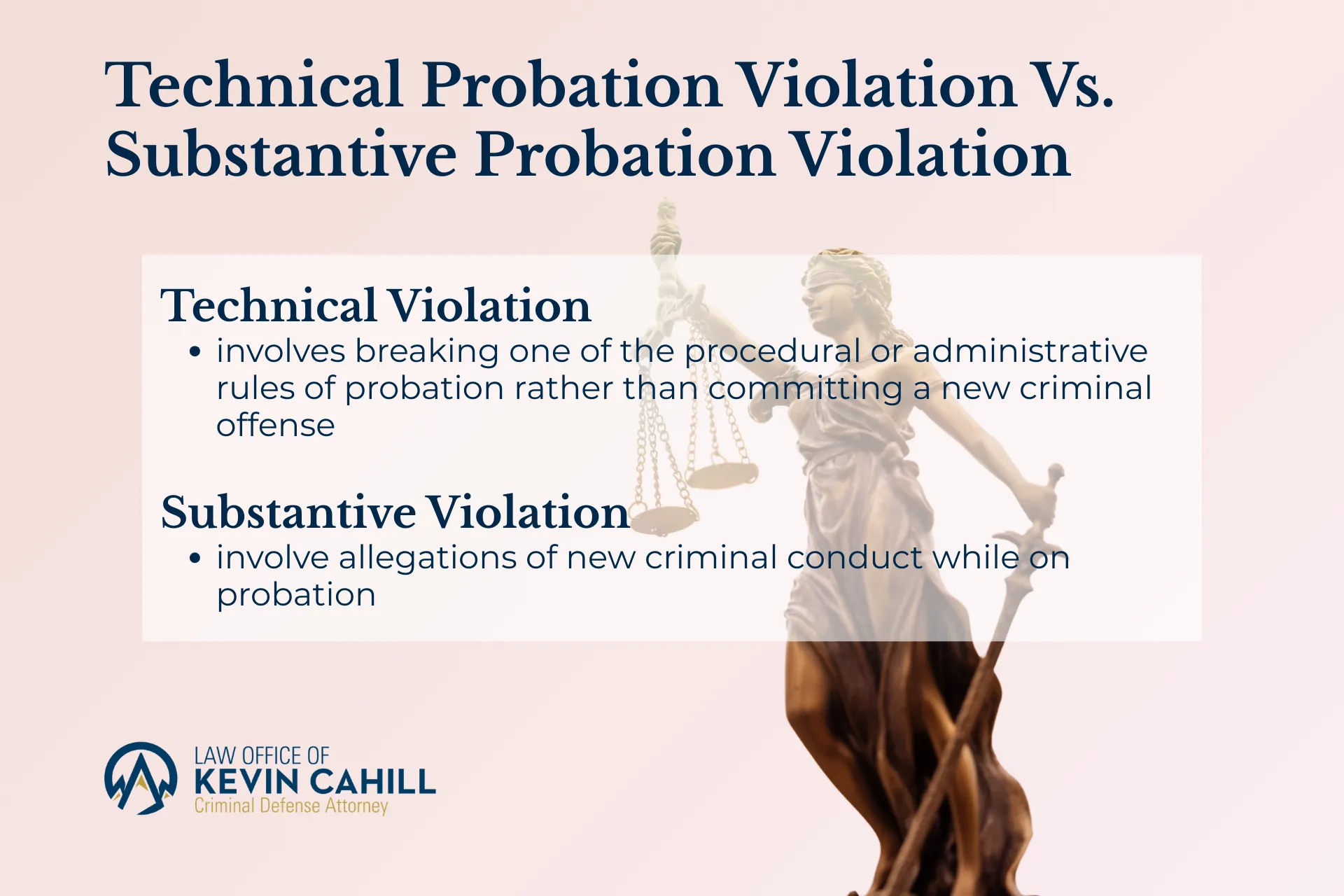
A probation violation in Colorado occurs when someone allegedly fails to comply with the conditions imposed by the court. These violations generally fall into two broad categories: technical violations and substantive violations.
A technical probation violation involves breaking one of the procedural or administrative rules of probation rather than committing a new criminal offense. These violations may include missing a probation appointment, failing to complete required classes or treatment programs, missing a scheduled drug test, or falling behind on court-ordered payments such as fines or restitution. Technical violations can sometimes occur because of misunderstandings, scheduling conflicts, or personal challenges such as transportation or financial difficulties. While courts still take these issues seriously, judges may evaluate whether the violation represents a temporary setback or a broader pattern of noncompliance.
Substantive violations, on the other hand, involve allegations of new criminal conduct while on probation. If someone is arrested for a new offense or accused of violating court orders in another case, that situation may trigger a probation violation proceeding. For example, a new arrest or a violation of bond conditions in a separate case can sometimes lead to allegations that probation terms were broken. When a violation is alleged, the court typically schedules a Colorado probation revocation hearing. This hearing is not the same as a criminal trial. Instead of proving guilt beyond a reasonable doubt, the prosecution must generally show that a violation occurred by a “preponderance of the evidence.” This means the judge must find it more likely than not that the violation occurred.
During the hearing, the court may review testimony from probation officers, evidence related to the alleged violation, and the individual’s overall compliance history. The judge may also consider whether the person has taken steps to address the issue, such as enrolling in treatment or correcting missed obligations.
If the court determines that a violation occurred, several outcomes are possible. In some cases, the judge may allow probation to continue with additional requirements or warnings. In other situations, the court may modify probation conditions or extend the probation period.
However, the court also has the authority to impose probation jail time in Colorado if it determines that incarceration is appropriate. In more serious cases, probation may be revoked entirely, which can result in the original suspended sentence being imposed.
Sentence Reconsideration, Appeals, and Relief
If probation is revoked and a new sentence is imposed, there may still be legal options available depending on the circumstances. Colorado law allows individuals to request certain forms of post-conviction review, though these processes are often time-sensitive and subject to strict procedural requirements.
One option that may be available is a motion for reconsideration of sentence. This type of motion asks the court to review the sentence and consider modifying it. Judges may evaluate factors such as rehabilitation efforts, compliance with court conditions, or changes in personal circumstances when considering these requests. Another potential option is filing an appeal. Appeals do not involve retrying the case but instead focus on whether legal errors occurred during the proceedings. Appellate courts review the record to determine whether the law was applied correctly.
In some situations, individuals may also pursue other forms of post-conviction relief, particularly if constitutional issues or newly discovered evidence are involved. These procedures are highly technical and depend on the facts of the specific case. Because of the complexity of these processes, individuals often benefit from understanding their options early and ensuring that important deadlines are not missed.
Frequently Asked Questions
Can all criminal records be sealed in Colorado?
No. Colorado law places limits on which offenses are eligible for record sealing. Eligibility often depends on the type of offense, whether the case resulted in a conviction, and how much time has passed since the case was completed.
How long do I have to wait to seal my record?
Waiting periods vary depending on the outcome of the case and the type of offense involved. Some dismissed cases may become eligible relatively quickly, while certain convictions require longer waiting periods after probation is completed.
Will a sealed record appear on background checks?
In most situations, sealed records do not appear on standard background checks conducted by employers or landlords. However, sealed records may still be accessible to courts and certain government agencies under specific circumstances.
What happens during a probation revocation hearing in Colorado?
During a Colorado probation revocation hearing, the judge reviews evidence to determine whether a probation violation occurred. If the court finds that a violation did occur, the judge then decides whether probation should continue, be modified, or be revoked.
Can probation violations lead to jail time?
Yes. Colorado probation jail time is one possible consequence of a violation. However, judges may also choose other options depending on the nature of the violation and the person’s history of compliance.
Final Thoughts
Facing an allegation of a probation violation in Colorado can be intimidating, especially when the possibility of jail is involved. However, the legal process does not automatically result in incarceration. Courts often examine the full context of the alleged violation before deciding what consequences are appropriate.
Through a probation revocation hearing in Colorado, judges evaluate the evidence, the individual’s compliance history, and whether the issue can be addressed through modifications to probation rather than jail. In many cases, the court’s decision depends on how the situation is handled and whether steps are taken to address the underlying problem.
For individuals concerned about potential probation jail time in Colorado or dealing with allegations of a technical probation violation or violation of bond conditions, the probation lawyers at Cahill Criminal Defense can assist you with probation issues and other post-conviction matters throughout the Denver area. Schedule a confidential consultation today.