
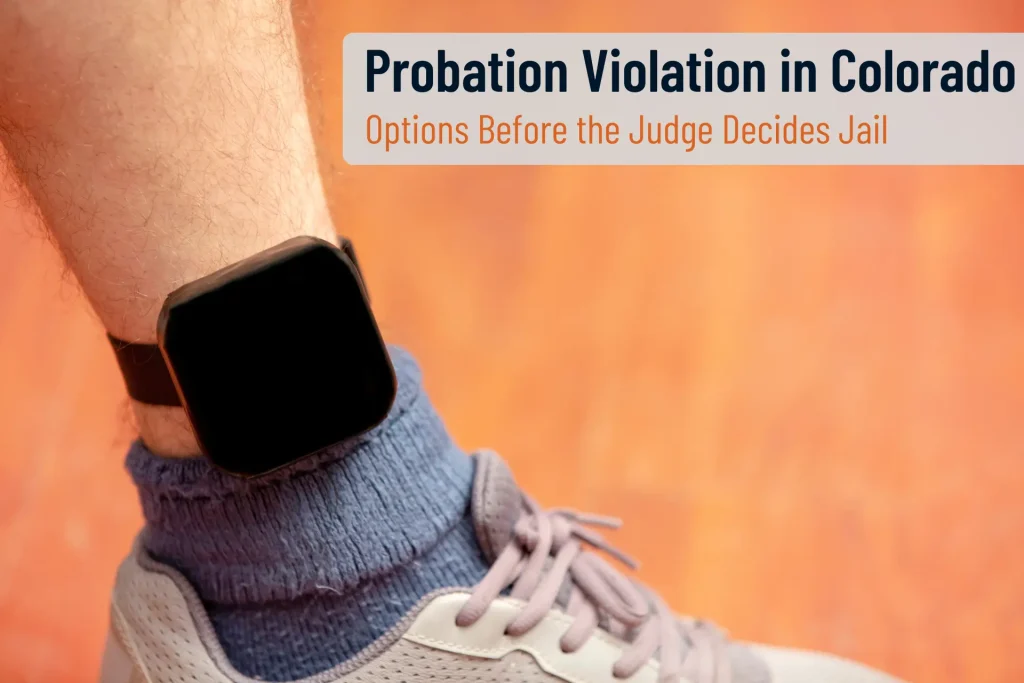
An accusation of a probation violation in Colorado can feel like a step back towards jail, but it is not a foregone conclusion. While the court has the authority to revoke your probation and impose the original, underlying sentence, incarceration is not the only outcome. An experienced defense attorney can help you explore numerous legal options, from seeking a modification of your probation terms to challenging the validity of the allegation itself.
Navigating a Probation Violation Complaint in Colorado
Receiving notice that your probation officer has filed a complaint against you is a deeply unsettling experience. You followed the rules, accepted the terms of your probation, and were moving forward with your life. Now, that progress feels threatened. This situation is stressful and confusing, but it is critical to understand that you have rights and options.
A probation violation occurs when you are alleged to have failed to comply with one or more of the specific conditions the court ordered as part of your sentence. This article is designed to be a clear guide through this challenging process. We will explain what constitutes a probation violation under Colorado law, detail the range of potential consequences, and explore the strategic approaches that can be taken to protect your freedom and keep you on the path to successfully completing your sentence.
Understanding Probation Violations Under Colorado Law
When a judge sentences you to probation, they are offering you an opportunity to serve your sentence in the community under supervision, rather than in jail or prison. This opportunity is conditioned upon your strict adherence to a set of rules. A complaint to revoke probation is the formal legal document, usually filed by your probation officer, that alleges you have broken one of those rules.
In Colorado, probation violations are generally categorized into two types:
Technical Violation
A technical violation is the most common type. It does not involve a new criminal act but rather a failure to comply with a specific administrative or rehabilitative condition of your probation. Common examples of a technical violation include:
- Missing a scheduled meeting with your probation officer.
- Failing a drug or alcohol test (a “hot UA”).
- Failing to pay court-ordered fines, fees, or restitution on time.
- Not completing mandated community service hours.
- Failing to enroll in or complete required therapy or treatment programs.
- Leaving the state without permission.
While these may seem minor, the court takes any failure to comply seriously.
New Law Violation
A new law violation, also called a substantive violation, is more severe. It occurs when you are arrested for or charged with a new criminal offense while you are on probation. This can be anything from a minor traffic offense like Driving Under Restraint to a serious felony. An allegation of a new crime is a direct violation of the standard probation condition to “remain law-abiding.”
The Legal Process and a Lower Burden of Proof
Once your probation officer files a complaint, the court will typically issue a summons for you to appear at a probation hearing or, in more serious cases, issue a warrant for your arrest. It is crucial to understand that a probation violation hearing is not a new criminal trial. The rights and procedures are different, and the prosecutor’s job is significantly easier.
In a criminal trial, the state must prove your guilt “beyond a reasonable doubt.” For a probation hearing, the prosecutor’s burden of proof is much lower; they only need to prove the violation by a “preponderance of the evidence.” This means the prosecutor only has to convince the judge that it is more likely than not (a greater than 50% chance) that you violated the terms of your probation. This lower standard makes it much more difficult to defend against an allegation without skilled legal representation.
Potential Penalties and Consequences of a Violation
At the conclusion of a probation hearing, the judge has broad discretion in deciding the outcome. Your future depends heavily on the nature of the violation, your history on probation, and the strength of the arguments presented on your behalf. A skilled probation violation lawyer in Denver will work to secure the most favorable outcome, emphasizing that jail is not the only, or best, option.
The judge may choose one of the following paths:
- Continuation/Dismissal: If your attorney successfully challenges the evidence, the judge may find that no violation occurred and dismiss the complaint. Your probation would then continue under its original terms.
- Reinstatement with a Warning: For a very minor, first-time technical violation, the judge might find that a violation did occur but choose to simply reinstate your probation with a stern warning to comply fully in the future.
- Modification of Probation: This is a very common outcome. The judge may decide to modify the terms of your probation rather than revoke it. This could involve making the conditions more restrictive. An experienced attorney can proactively file a motion to modify probation, suggesting reasonable new terms as an alternative to incarceration. Modifications might include:
- Increased frequency of drug or alcohol testing.
- Mandatory enrollment in a more intensive treatment program.
- A short “shock” jail sentence (e.g., a weekend or a week) as a sanction before continuing probation.
- The addition of electronic monitoring or a curfew.
- Revocation and Imposition of Sentence: This is the most severe consequence. If the judge chooses to revoke probation, they can then sentence you to any penalty that was legally available for your original offense. If you had a two-year prison sentence hanging over your head as part of a deferred judgment or suspended sentence, the judge can now impose that full term.
Beyond these direct legal penalties, a probation violation can have serious collateral consequences, impacting your employment, housing opportunities, and any professional licenses you may hold.
Strategic Approaches to a Probation Violation Hearing
Facing a probation violation complaint can feel overwhelming, but you are not without options. A proactive and strategic defense is essential. An experienced criminal defense attorney can analyze the specifics of your case and build a compelling argument for the judge.
Disclaimer: The following are examples of potential strategies and do not constitute legal advice. Every case is unique, and you must consult with a qualified attorney about your specific circumstances.
Potential defense strategies may include:
- Negotiating a Resolution Before the Hearing: Often, the most effective work is done before you ever step into the courtroom. A defense attorney can open lines of communication with your probation officer and the District Attorney to negotiate an agreement, such as a probation modification, that resolves the issue without a contentious hearing or the risk of revocation.
- Challenging the Allegation Itself: Do not assume the allegation is true or unassailable. Was a drug test administered correctly? Is there proof of a legitimate emergency that caused you to miss a meeting? An attorney can scrutinize the evidence presented by the prosecution and challenge its accuracy or sufficiency.
- Presenting Mitigating Evidence: Context is critical. It is vital to explain to the judge why the violation may have occurred. Perhaps you lost your job and couldn’t afford to pay your fines, or a family crisis prevented you from attending a required class. Presenting evidence of these circumstances is not an excuse, but it provides the judge with a more complete picture, which can lead to a more compassionate outcome.
- Demonstrating Proactive Compliance: One of the most powerful strategies is to show the court that you are taking the situation seriously. Before your hearing, you can take proactive steps to get back into compliance. This could mean voluntarily enrolling in a treatment program, catching up on all missed payments, or completing your community service hours. These actions demonstrate responsibility and a genuine desire to succeed on probation.
Frequently Asked Questions
What is the difference between a technical violation and a new law violation?
A technical violation is a failure to follow the administrative rules of your probation, such as missing a meeting or failing a drug test. A new law violation (or substantive violation) is far more serious and involves being arrested for or charged with a new crime while on probation.
Will I automatically go to jail for a probation violation in Colorado?
No, jail is not automatic. The judge has a wide range of options, from simply warning you and continuing your probation to modifying the conditions. The outcome often depends on the severity of the violation, your overall performance on probation, and the quality of your legal representation.
How soon do I need a lawyer for a probation violation?
You should contact an attorney immediately. The sooner you have legal counsel, the more time your attorney has to investigate the allegation, communicate with the probation officer and prosecutor, and prepare a strong strategy for your probation hearing. Early intervention provides the best opportunity to avoid the harshest penalties.
Can my probation be modified instead of revoked?
Yes. Modifying the terms of probation is a very common resolution to a violation complaint. A defense attorney can argue that adding a condition—like more frequent testing or additional therapy—is a more constructive solution than revoking your probation and sending you to jail.
Protect Your Freedom and Your Future
An allegation of a probation violation jeopardizes the freedom you have worked hard to maintain. The legal standard is lower, and the consequences are severe. However, it is a situation that can be managed with a strategic, proactive approach. You have options beyond simply waiting for a judge to decide your fate.
Taking swift action and securing expert legal guidance is the most important step you can take. An experienced attorney can defend your rights, present your side of the story effectively, and fight for a resolution that allows you to get back on track and successfully complete your probation.